

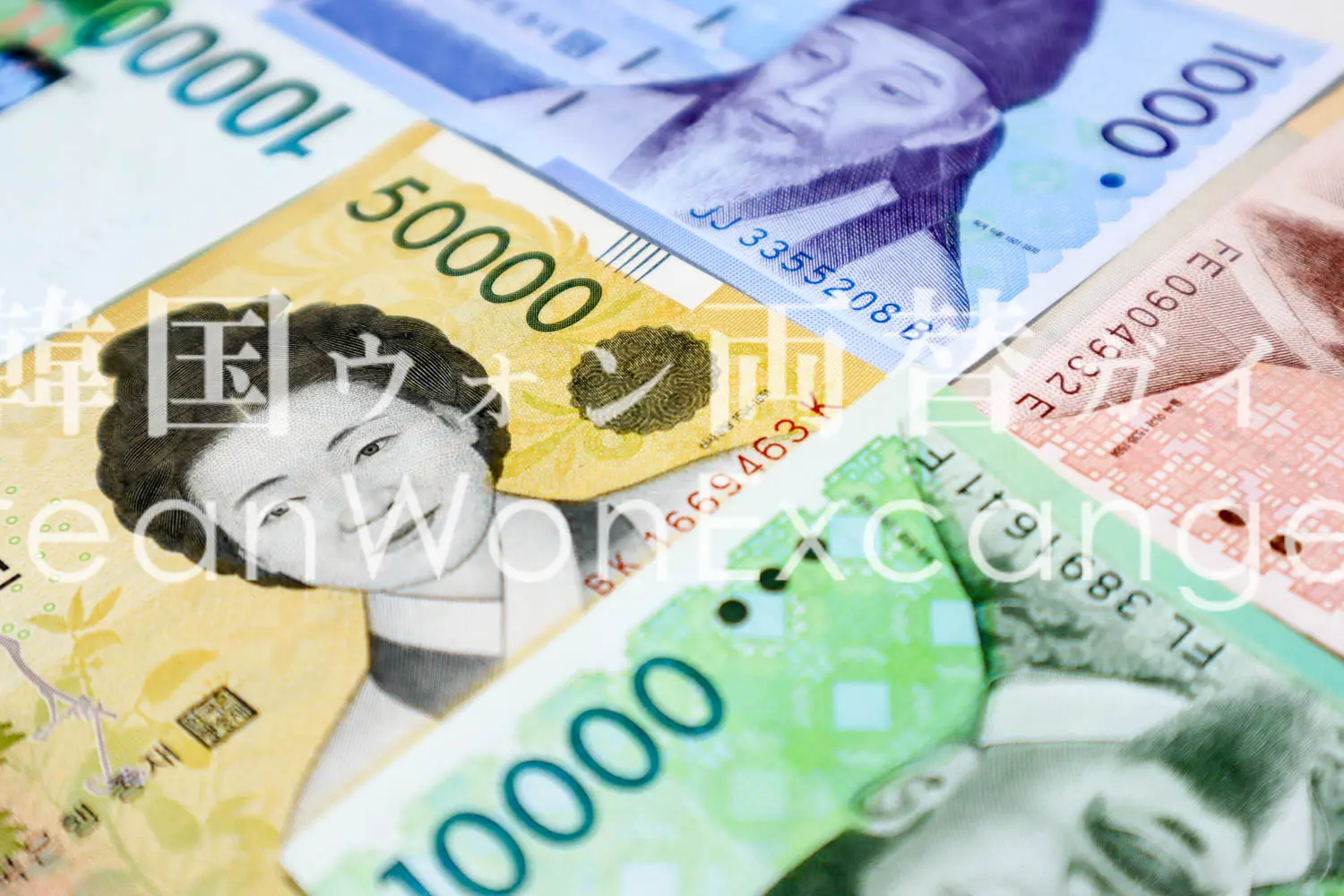
The bottom line
The bottom line — stop exchanging at airports. That alone saves you over JPY 10,000 in needless fees per JPY 100,000.
First, avoid exchanging at Japan's airports. They are the worst option here — Narita's counters score the lowest in this comparison. We use Narita as the worst-case baseline and show how much more you receive with each alternative. Incheon Airport gives you 4,420 JPY more than Narita, but next to WOWPASS or Myeongdong below, that difference is not impressive.
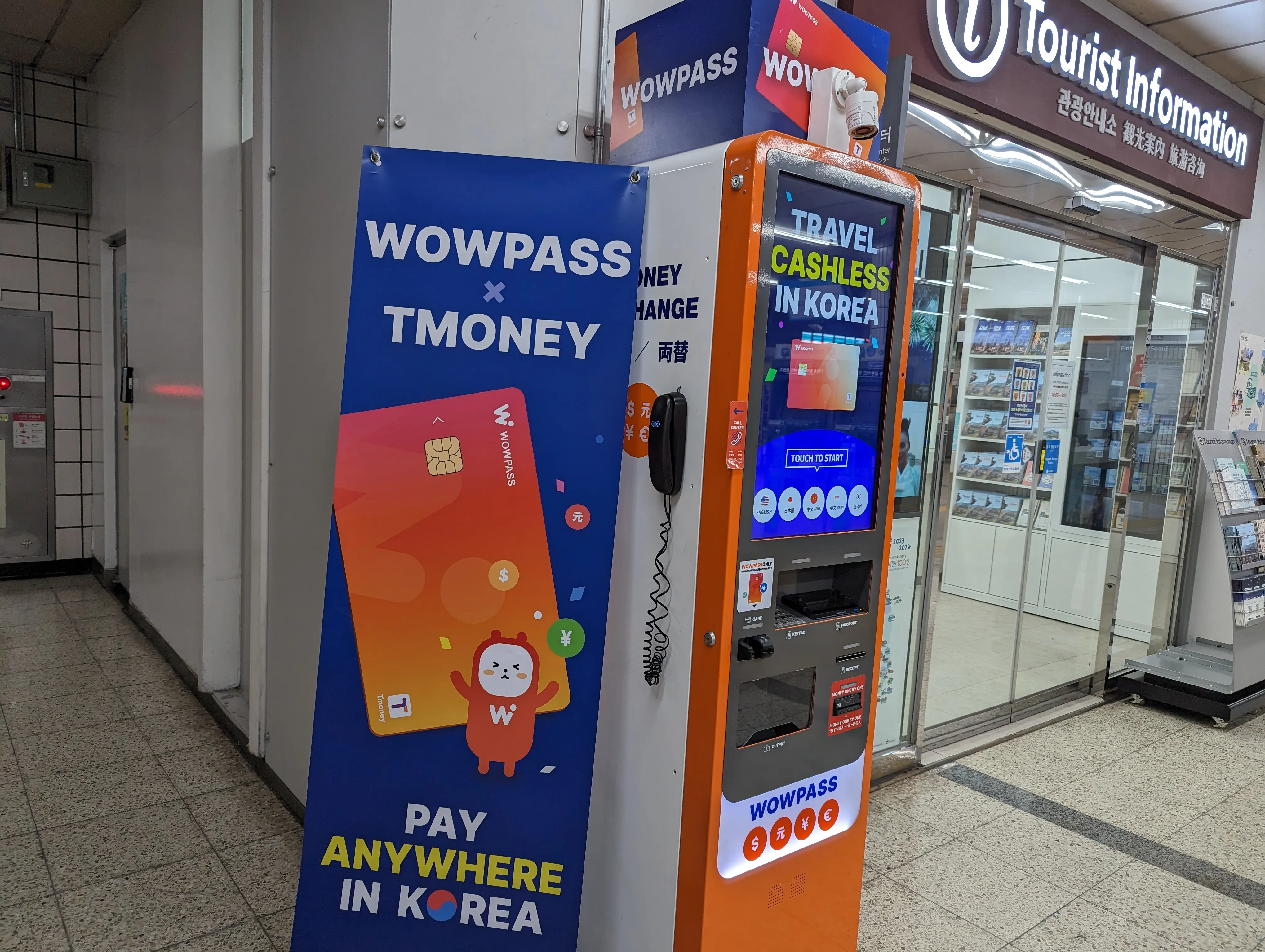
The top candidate is WOWPASS. For JPY 100,000, you receive 9,451 JPY more than at Narita. On top of that, kiosks are installed at 438 locations across Korea's major districts, stations, and airports, with the same rate available 24/7. Late-night arrivals, transit transfers, or a quick convenience-store-style top-up — it all works.
The cheapest is Myeongdong exchange counters. For JPY 100,000, you receive 10,917 JPY more than at Narita. The catch is the trip to Myeongdong itself, so the answer depends on whether it fits your itinerary. The gap vs. WOWPASS is 1,466 JPY per JPY 100,000 — whether it is worth the trip depends on how much you are exchanging.
And there is a hybrid: exchange won in Myeongdong, then top up your WOWPASS with that cash. You get Myeongdong's rate paired with WOWPASS's spending convenience — the best of both for people topping up a larger amount.
For the best rate, Myeongdong.
For convenience, WOWPASS.
A rule of thumb by amount: for small amounts up to a few JPY 10,000s, WOWPASS (the gap with Myeongdong is small and the travel cost is bigger); for serious amounts above JPY 50,000, Myeongdong (the gap stops being ignorable). The one option you can rule out from the start is the airport.
Rate gaps by exchange method
The table below shows auto-fetched rates as of 2026/10/10. For each method, it also shows how much more you receive than at Narita, one of the worst options in Japan, when exchanging JPY 100,000. The ranking generally holds even as rates move.
on a JPY 100,000 basis
- MoneyBox in MyeongdongWithin 200 m of the Chinese embassy84,600₩10,917 JPYgain
- WOWPASS top-up438 kiosks nationwide · same rate 24/783,359₩9,451 JPYgain
- Credit-card paymentVISA · including the 3.85% overseas fee81,387₩7,122 JPYgain
- Incheon International AirportKB Kookmin / Woori / Hana Bank79,100₩4,420 JPYgain
- Narita AirportExchange counters inside the airport75,358₩baseline
- Kansai AirportAbout the same as Narita74,627₩864 JPYloss
Note: Auto-fetched rates as of 2026/10/10. The right column shows the difference vs. exchanging JPY 100,000 at the Narita counter — gain means more KRW than Narita, loss means worse than Narita. Rates for Myeongdong, WOWPASS, airport banks, and others are updated daily. For more detail, see today's rate comparison.
What to know before you exchange
Your passport is required. Money exchange in Korea always requires presenting your passport. Copies and phone photos are not accepted. Whether at an exchange counter or an airport bank, without it you will not be served. WOWPASS kiosks also scan your passport on the first purchase.
The number of exchange counters dropped significantly during COVID. They were already concentrated in tourist areas like Myeongdong, Dongdaemun, and Hongdae, and the pandemic thinned them further. Today, the area around the Chinese embassy in Myeongdong and Namdaemun is still the center; outside of it, finding an exchange counter has become difficult. Depending on where you stay and your itinerary, stopping by one may not be realistic.
WOWPASS kiosks are installed at 438 locations across Korea. Of those, 290 are in Seoul. By area: Myeongdong / Euljiro has 81, Gangnam / Samseong / Jamsil has 35, Hongdae 30, Dongdaemun 28, the recently popular Seongsu / Konkuk Univ. area 16, and Insadong / Anguk / Jongno 26. In any area a tourist actually visits, you can find one — which compensates for the uneven distribution of exchange counters.
The top pick — Myeongdong: worth a stop if you can swing by
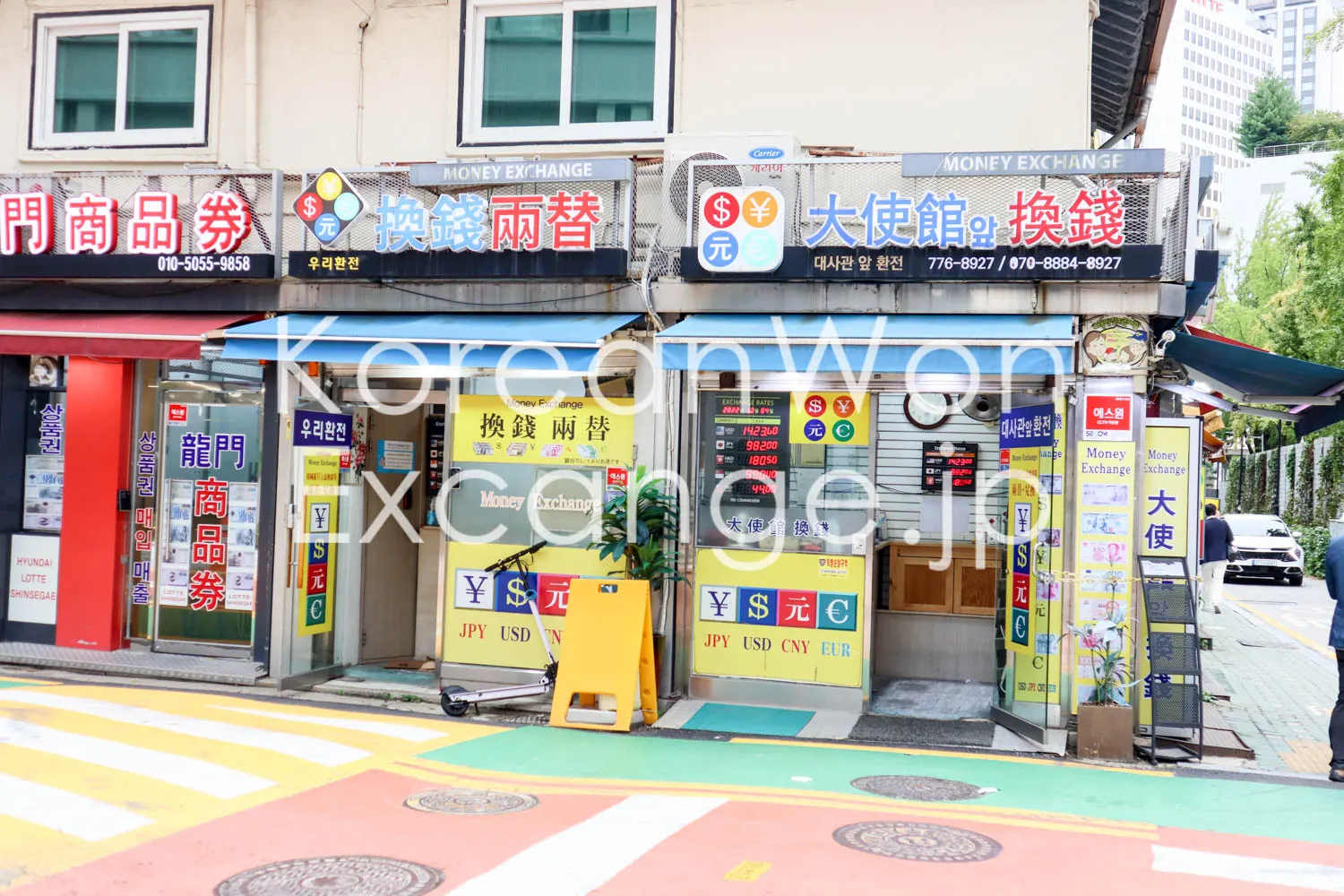
Myeongdong has a dense cluster of exchange counters within 200 m of the Chinese embassy. The two with the best rates are the counter right in front of the embassy and MoneyBox Myeongdong — rates are about the same at either. MoneyBox is a chain that expanded rapidly across Korea after the pandemic: clean stores and Japanese-language support make it easy to walk into even for a first-time exchange.
For JPY 100,000, you receive 10,917 JPY more than at Narita. This is the cheapest of all options covered in this article. The gap vs. WOWPASS (9,451 JPY more than Narita) is 1,466 JPY — whether you can trade that amount for "the trouble of getting to Myeongdong" is the decision point.
If Myeongdong or Namdaemun is already in your itinerary, or your hotel is nearby, there is plenty of reason to stop by and exchange. Conversely, if your hotel is far from Myeongdong or you do not have time to make a detour, WOWPASS is the realistic choice. Decide based on whether "moving for 1,466 JPY" fits your trip.
There is one more option: exchange won in Myeongdong, then top up your WOWPASS with that cash. WOWPASS kiosks accept not only JPY but Korean won in cash as well, so you can combine Myeongdong's rate × WOWPASS's spending convenience. For someone who can stop by Myeongdong and wants to use WOWPASS for a larger amount, this is the most cost-effective approach.
Hours at both are short — around 10:00–19:00 — so they are closed at night and early morning. The "24-hour exchange at 7-Eleven Myeongdong" mentioned in older articles closed during the pandemic; be careful with outdated sources.
The convenience pick — WOWPASS
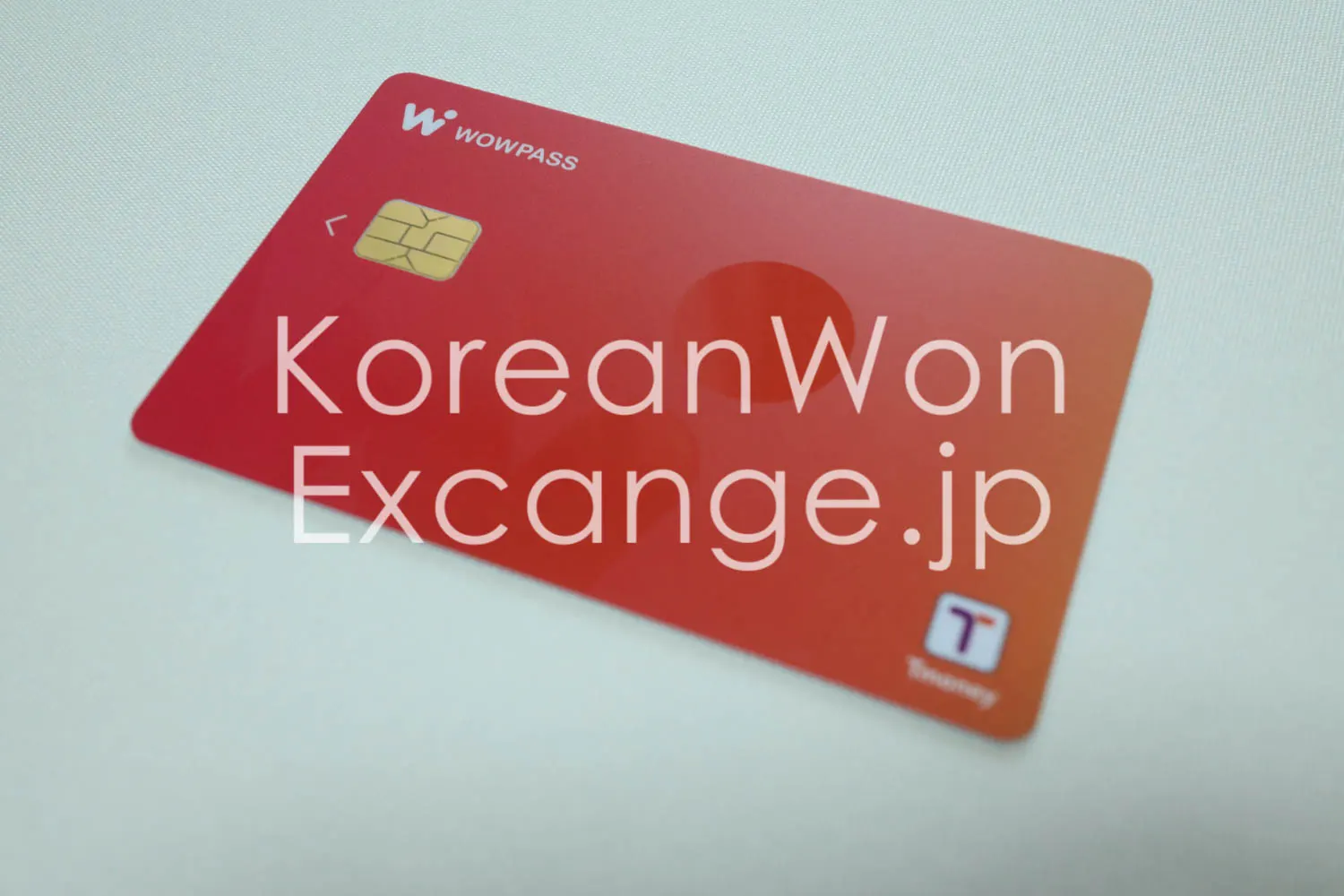
WOWPASS is a Korea-only prepaid card that doubles as T-money. Kiosks that accept cash top-ups in 14 currencies including JPY and USD are installed across Korea's major districts, stations, and airports.
For JPY 100,000, you receive 9,451 JPY more than at Narita. It loses to Myeongdong (10,917 JPY more) by about 1,466 JPY per JPY 100,000. On the other hand, vs. Incheon Airport (4,420 JPY more), you get 5,031 JPY extra. 24/7 top-up plus built-in T-money — that simplicity is the strength.
Top up 24/7, in business districts and at stations
Installed along major travel routes nationwide — Seoul Station, Myeongdong, Gangnam, Hongdae, Dongdaemun, Yongsan, the main Busan stations, and Incheon / Gimpo airports. Late-night arrivals, after the last train, mid-trip transit — all at the same rate.
T-money built in — one card for transit too
Works as T-money on subways, buses, and some taxis. No need to buy a separate T-money card. The WOWPASS balance and the T-money balance are managed separately, but you can move money from your WOWPASS balance to your T-money balance from the app — no need to visit a top-up kiosk at the station. NFC in the app lets you check both balances with one tap.
Fees are simple
Issuance 5,000 KRW / cash withdrawal 1,000 KRW / reissuance 3,000 KRW. Top-ups, payments, and the annual fee are all free. A standalone T-money card itself costs 3,000 KRW, so think of the 5,000 KRW as buying a card that also includes T-money — the actual cost is small.
Enter the invite code for
cashback.
Enter the code below during your first WOWPASS app sign-up to receive 0.5% (up to 5,000 KRW) cashback on foreign-currency top-ups.
the app
from banner
card
Enter the code before registering your WOWPASS card in the app.After card registration, the invite code can no longer be entered. See how to enter →
5 pitfalls to watch out for with WOWPASS
01Never top up with a credit card
You can top up WOWPASS with a credit card via the app, but WOWPASS's 4.2% credit-card top-up fee plus your card's 2.2% overseas fee stack. The resulting rate ends up about the same as Incheon airport banks. You are better off just paying with the credit card directly in store — a feature to avoid at all costs. Always top up with cash at the kiosk.
02Do not confuse "WOWPASS top-up" with "WOW EXCHANGE"
The same machine has two menus: topping up WOWPASS and exchanging cash directly (WOW EXCHANGE). On a JPY 10,000 basis, the receive rate differs — 83,359₩ (top-up) vs. 8,174,901₩ (cash exchange). For JPY 100,000 vs. Narita, they are 9,451 JPY gain vs. 9,567,742 JPY gain. The gap is about -9,558,291 JPY, so do not pick the wrong menu on screen.
03You cannot withdraw cash at Incheon Airport kiosks
The kiosks at Incheon T1 / T2 do not support withdrawal (only top-up and payment). This bites on both arrival and departure. On arrival, you may want cash for the taxi but cannot pull it from your WOWPASS balance at the airport. On departure, you cannot convert any leftover balance back to cash. The moment you reach Incheon with balance left, the cash-out option is gone. Withdraw cash at Seoul Station, Myeongdong, Gangnam, or Gimpo Airport Station kiosks in the city beforehand.
04Only some kiosks pay out in Japanese yen
Withdrawals are normally in KRW cash, but some kiosks support payout in JPY 10,000-yen notes. Note that only JPY 10,000 notes come out — change under JPY 10,000 does not automatically come out in won. You either leave the change in the balance or do a separate operation to withdraw it as KRW. For specific kiosk locations that support JPY withdrawal, search the JPY-withdrawal-capable WOWPASS kiosks list.
05Tap payments are drawn from the T-money balance
When you tap on a subway or bus, the fare is drawn from your T-money balance (managed separately from your WOWPASS balance). Just topping up WOWPASS does not let you use it for transit, so you can end up short at the gate. The easiest way to move money to the T-money balance is to top up T-money from your WOWPASS balance via the app (you can also use a station top-up machine).
You can check today's rates on the rate comparison page as well.